






I spent time with Green Dot - Mobile Banking as a straightforward finance app rather than treating it like a full replacement for every banking tool. That distinction matters. Green Dot, developed by Green Dot, is built around giving customers a mobile way to manage their banking relationship, check activity, and handle everyday money tasks from a phone. Its store summary, “Your banking. Your choice,” points to the app’s basic appeal: access should feel more convenient and less tied to a desktop or branch visit.
The app is free to download and is suitable for Everyone, which makes its audience broad. It has been available since May 17, 2011, and the current version is 4.69.5 for devices running Android 7.0 or later. With more than five million installs, it is clearly used by a substantial number of people, although its average rating of 3.5 from roughly ninety-one thousand ratings suggests a mixed experience rather than universal satisfaction. I think that is a fair starting point: this is useful banking software, but your experience will depend heavily on what you expect it to do and how smoothly your account setup and daily habits fit the app.
How I would use it for everyday banking
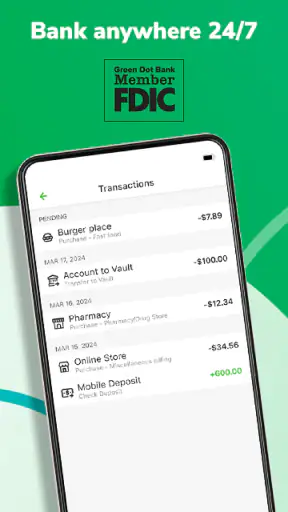
My preferred way to use Green Dot Mobile Banking is as a quick control panel for routine money checks. I would open it when I want to see what has happened in the account, confirm whether a recent purchase has appeared, or review the available balance before spending. That sounds simple, but it is exactly where a finance app earns its place on a phone. A banking app does not need to turn every action into a complicated process; it needs to help me answer basic questions quickly and confidently.
The first habit I recommend is checking the account before making a purchase that could bring the balance close to its limit. This is particularly useful when several recent transactions have not yet become part of the balance I am mentally tracking. Instead of relying on memory, I can make the app the final checkpoint. I would also review activity after a busy day of spending, not because every transaction needs investigation, but because a short review makes unfamiliar activity easier to notice.
A realistic example is a grocery trip followed by a fuel purchase and a subscription renewal on the same day. I might remember the first two and forget the third. Opening the app later gives me a single place to compare the activity with my own records. If something looks unfamiliar, I can investigate while the details are still fresh. That habit is more valuable than simply opening the app when money is already tight.
I also like separating two jobs that people often mix together: checking what is available now and planning what will be available later. Green Dot Mobile Banking is convenient for the first job. For longer-term planning, I would still use a simple budget, notes, or a spreadsheet if I needed categories, forecasts, or a detailed view across several accounts. The app can be the source of current account information without having to become my entire financial planning system.
That is one of the most important trade-offs. Someone who wants a focused mobile banking experience may appreciate the directness. Someone expecting the deep budgeting tools found in specialized finance apps may find the experience narrower. I would not judge it harshly for that difference, but I would decide before installing whether my priority is account access or full financial analysis.
Build a repeatable checking routine
Experienced users usually get more from a banking app through consistency than through constant tapping. I would choose two natural moments for checking: after the day’s spending and before a larger payment or transfer. The point is not to stare at the balance repeatedly. It is to create a reliable routine that reduces surprises.
When reviewing activity, I would look at the transaction description, amount, and timing instead of only scanning the final balance. A balance can look reasonable while one incorrect or forgotten transaction remains unnoticed. I would also avoid treating a pending-looking item as a completed record until I understand how it is represented in the account. Banking activity can change as transactions settle, so a single glance should not replace a second check when the amount matters.
This is a small but non-obvious advantage of using the app deliberately: it becomes a record-keeping aid, not merely an emergency balance button. If I make a purchase that I expect to appear, I can use the next review to confirm the account reflects it. If I am sharing household expenses, I can also use the activity view as a factual reference rather than trying to reconstruct spending from memory.
Settings I would check before relying on it
Before making Green Dot Mobile Banking part of my routine, I would review the app’s available account and security settings carefully. I would make sure my contact details are current, confirm that I understand the sign-in process, and check how the app presents alerts or account activity notifications. I would not assume that the default configuration matches the way I want to monitor money.
Notifications deserve special attention. I prefer alerts that help me notice meaningful activity without turning every ordinary event into background noise. If the app offers choices over notification types, I would start with the events most useful for security and balance awareness, then adjust after a few days. Too many alerts encourage people to dismiss everything; too few can make unusual activity easier to miss. The best setting is the one I will actually pay attention to.
I would also check whether the app remembers any display preferences, account-selection choices, or privacy-related options that affect how quickly I can reach the information I need. I do not treat convenience as a reason to weaken device security. A fast shortcut is only helpful if the phone itself is protected and I remain comfortable with how account information appears on screen.
One practical tip is to test the sign-in and recovery path before an urgent situation occurs. I would rather learn how the app handles a forgotten credential while I am calm than discover the process when I am standing at a checkout. The same applies to keeping the app updated. The current release, 4.69.5, supports Android 7.0 and newer, so compatibility is worth checking before depending on it on an older device.
These checks do not make the app more powerful, but they make it more dependable in real life. A banking app is part of a chain that includes the phone, the operating system, account credentials, notifications, and the user’s own habits. Green Dot Mobile Banking works best when I configure that chain intentionally instead of assuming the first launch is the finished setup.
Shortcuts that make routine actions less tiring
The fastest workflow is usually the one that avoids unnecessary decisions. I would keep the app in a predictable place on my phone, use the same review sequence each time, and avoid opening it without a specific question in mind. My sequence would be: sign in, check the current balance, scan recent activity, and leave once I know what I needed to know. That sounds almost too basic, but it prevents a quick check from becoming aimless scrolling.
For recurring expenses, I would maintain a separate reminder outside the app if I need advance notice. The banking app can confirm that a payment appeared, while a calendar or budget note can remind me that it is coming. Combining those tools is more practical than expecting a mobile banking app to serve as a complete planning calendar. This is especially useful for bills that do not occur every week and are easy to overlook.
I would also use a “before and after” habit for important transactions. Before sending money or making an unusually large purchase, I would check the available balance and confirm the destination or details carefully. Afterward, I would return to the activity screen to verify the result. That two-step pattern adds a little time, but it reduces the chance of confusing an intended action with a completed one.
Another useful pattern is keeping account questions separate from spending decisions. If I notice an unfamiliar item, I would not immediately make another transaction just to test the balance. I would first understand the activity, then decide what to do. This protects me from reacting to incomplete information and helps keep the app’s record distinct from my assumptions.
Green Dot Mobile Banking is also more approachable when I use it in short sessions. I would not expect a finance app to replace a monthly review of broader finances. Instead, I would use the phone for immediate account awareness and reserve deeper decisions for a calmer session with more context. That division makes the app feel faster because I am asking it to do the job it handles best.
Where the limits become important
The main limitation is not necessarily a missing button; it is the risk of expecting one account app to cover every financial need. If I need detailed category tracking, a combined view of several institutions, investment monitoring, or a long-range cash-flow forecast, I would compare Green Dot Mobile Banking with a dedicated budgeting or financial aggregation tool. Those alternatives may be better for analysis, even if they are less direct for managing the Green Dot account itself.
I would also be cautious about using any mobile banking app as the only place where I keep important financial information. For regular planning, I would maintain my own record of bills, goals, and expected income. The app is valuable for current account activity, but personal records help me understand patterns that a transaction list alone may not explain. This is not a criticism unique to Green Dot; it is a sensible boundary for mobile banking in general.
Users with older phones should pay attention to the operating-system requirement. Android 7.0 is the minimum listed version, so a device below that threshold is not a suitable foundation for relying on this app. People who need an iPhone experience should also choose the appropriate platform download rather than assuming that an Android installation path applies everywhere. The important point is to confirm the device fit before moving essential banking tasks into the app.
The mixed average rating also tells me to keep expectations realistic. A rating of about three and a half stars from around ninety-one thousand ratings indicates that many people find value in the app while others encounter friction. I would not interpret that as proof that it will fail for a particular user, but I would take it as a reason to test the everyday workflow early. Can I sign in comfortably? Can I locate activity without confusion? Do the notifications help rather than distract? Those answers matter more than a headline score.
People who dislike managing money from a phone, need extensive financial reports, or want one dashboard for many unrelated accounts may be happier with a traditional bank website, a spreadsheet, or a specialized finance application. Someone who mainly wants convenient access to Green Dot banking on a compatible phone is a much better match. The app’s value comes from directness, not from trying to be every financial tool at once.
My verdict after using it as a habit
I see Green Dot Mobile Banking as a practical companion for people who want their everyday banking close at hand. Its free price, broad Everyone age rating, established availability, and large install base make it an accessible option to consider. More importantly, it supports a sensible routine: check the balance, review activity, confirm important transactions, and use separate tools when planning becomes more complex.
I would recommend it to a friend who already uses Green Dot and wants a mobile way to stay aware of account activity. I would especially recommend setting up a small repeatable process instead of judging the app after one hurried launch. Review the settings, choose useful notifications, test the sign-in path, and decide what information you need before opening it. Those steps make the experience more efficient than relying on spontaneous checks.
I would not recommend choosing it solely because it is free or because millions of people have installed it. Those details make it easy to try, but they do not guarantee that the workflow suits everyone. If your priority is advanced budgeting, multi-account analysis, or detailed forecasting, a different finance tool may serve you better. Green Dot’s strength is more focused: it gives me a convenient mobile window into everyday banking, provided I use it with realistic expectations.
My final view is positive but measured. The best results come from pairing the app with disciplined habits, not from expecting the app to make financial decisions for me. Used that way, Green Dot Mobile Banking is a useful, approachable finance app for routine account awareness. It is not a substitute for personal planning, but it can make the daily part of managing money quicker, clearer, and easier to repeat.


